
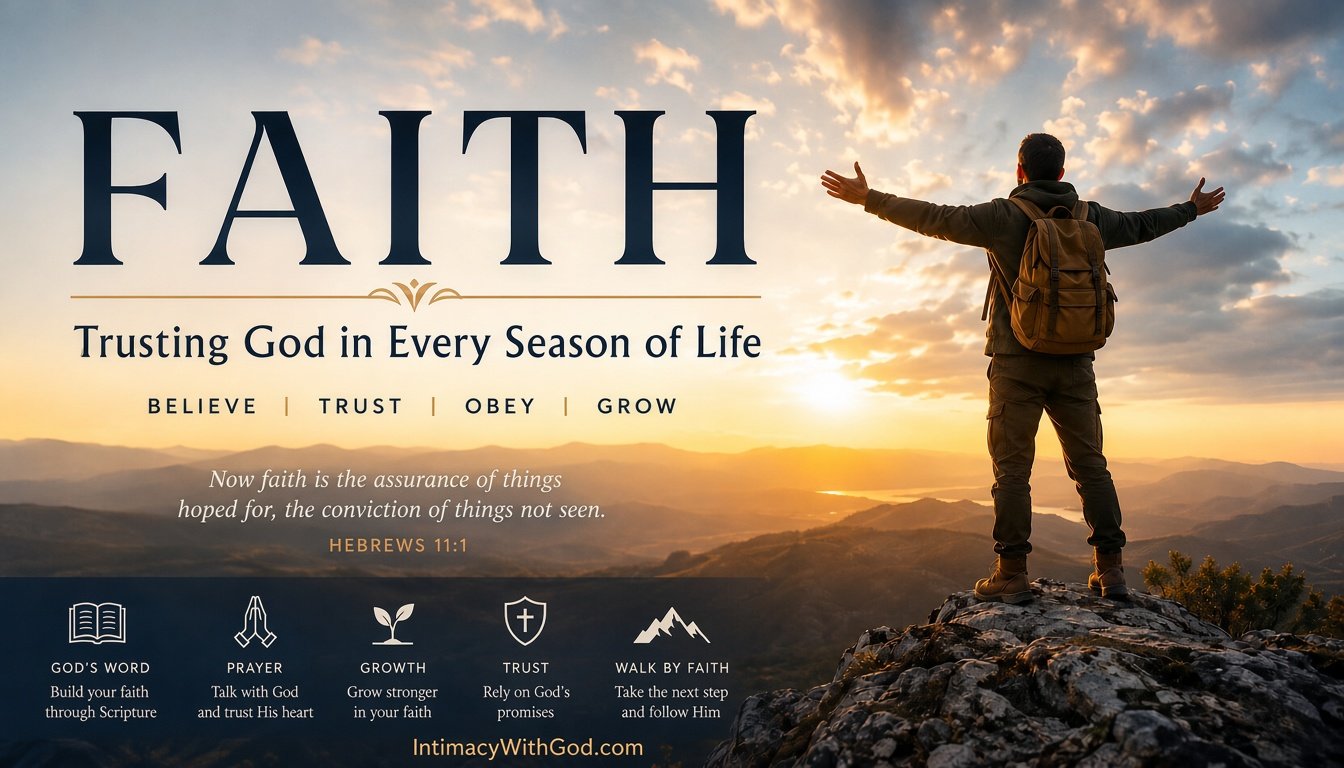
Faith: How to Grow Stronger In Faith and Trust God
What Is Faith?
Faith is at the heart of the Christian life. Faith is believing in God, trusting His character, relying on His promises, and choosing to follow Him even when you cannot see everything clearly.
The Bible describes faith as “the assurance of things hoped for, the conviction of things not seen” (Hebrews 11:1, ESV). Faith does not mean pretending that difficulties do not exist. Instead, biblical faith means trusting God in the middle of those difficulties.
Faith is more than simply believing that God exists. It is developing a relationship with Him in which you learn to trust His wisdom, His goodness, His promises, and His direction for your life.
As your faith grows, your relationship with God can become deeper and more personal. You begin to rely less on your own understanding and more on God's character and His Word.
Why Is Faith Important in the Christian Life?
Faith is essential to knowing God and walking with Him.
Hebrews 11:6 says:
“And without faith it is impossible to please him.”
Faith allows us to approach God with confidence, depend on Him in difficult circumstances, and follow Him when we do not know what the future holds.
Faith also changes how we respond to life's challenges.
Without faith, fear can become the dominant voice in our lives. With faith, we can face uncertainty while remembering that God remains faithful.
Faith does not guarantee that life will always be easy. Instead, faith gives us confidence that God is with us in every circumstance.
What Does the Bible Say About Faith?
The Bible contains hundreds of references to faith and trusting God. From Genesis through Revelation, Scripture demonstrates the importance of believing God and responding to Him in faith.
The people of God repeatedly faced situations in which they had to trust Him.
Abraham trusted God's promise even when he could not see how that promise would be fulfilled. Moses trusted God when leading Israel out of Egypt. David trusted God when facing enemies. The prophets trusted God when circumstances appeared hopeless.
The New Testament places faith at the center of our relationship with Jesus Christ.
Ephesians 2:8–9 teaches that salvation is by grace through faith. Romans 10:17 explains that faith comes from hearing the word of Christ.
Faith therefore involves both believing God and responding to what He has revealed.
Faith in God Means Trusting God
One of the most important aspects of faith is learning to trust God.
Trusting God means believing that His character is good even when your circumstances are difficult.
Sometimes God answers prayer in ways we expect. Sometimes His answer looks completely different from what we anticipated. Sometimes we have to wait.
Faith allows us to say:
“God, I don't understand everything that is happening, but I trust You.”
Proverbs 3:5–6 gives one of the clearest biblical descriptions of trusting God:
“Trust in the LORD with all your heart, and do not lean on your own understanding.”
This kind of trust is foundational to a growing relationship with God.
How to Have Faith in God
If you want to develop stronger faith, begin by intentionally building your relationship with God.
1. Know God Through His Word
Faith grows when we learn who God is.
The Bible reveals God's character, His promises, His faithfulness, His holiness, His love, and His purposes.
Romans 10:17 says:
“So faith comes from hearing, and hearing through the word of Christ.”
Regular Bible reading and Bible study help you develop a biblical understanding of God.
Don't simply read the Bible looking for information. Ask:
- What does this passage teach me about God?
- What does it reveal about His character?
- What does God want me to believe?
- Is there something I need to trust Him with?
- How should I respond to what I have learned?
As you know God better, trusting Him becomes more natural.
2. Spend Time in Prayer
Faith and prayer are closely connected.
Prayer gives you an opportunity to bring your fears, questions, needs, hopes, and desires before God.
Prayer is not simply asking God for things. It is also listening, worshiping, surrendering, thanking, confessing, and developing a deeper relationship with Him.
When you regularly experience God's faithfulness in prayer, your confidence in Him can grow.
3. Remember God's Faithfulness
One of the best ways to strengthen your faith is to remember what God has already done.
When you face a new difficulty, remember previous times when God helped, provided, guided, strengthened, or encouraged you.
Psalm 77:11 says:
“I will remember the deeds of the LORD.”
Remembering God's faithfulness can help you face today's uncertainty with greater confidence.
4. Obey God
Faith is demonstrated through action.
James 2 emphasizes that genuine faith produces works.
It is possible to say that you believe God while continually refusing to follow Him. Biblical faith involves responding to God with obedience.
Sometimes faith means taking the next step even when you do not know what will happen afterward.
5. Surrender Your Fears to God
Fear and faith often compete for our attention.
When you are constantly focused on everything that could go wrong, it becomes difficult to rest in God's faithfulness.
Faith does not mean you will never experience fear. It means you learn to bring your fear to God instead of allowing fear to control you.
Philippians 4:6–7 encourages believers to bring their anxieties to God through prayer and thanksgiving.
How to Grow in Faith
Faith is not meant to remain at the same level throughout your Christian life.
God wants you to grow spiritually.
Just as physical muscles become stronger through exercise, faith can become stronger as you repeatedly trust God.
Read the Bible Consistently
Make God's Word part of your daily life.
You do not have to read enormous amounts of Scripture every day. Consistency is often more important than quantity.
Read slowly. Think about what you read. Pray about it. Apply it.
Pray Even When You Don't Feel Strong
You don't have to wait until you feel full of faith before you pray.
A powerful prayer found in Mark 9:24 says:
“I believe; help my unbelief!”
This is an honest prayer.
You can bring both your faith and your doubts to God.
Step Out in Faith
Sometimes faith grows when we obey God in situations that require dependence upon Him.
You may not know the entire plan. You may only know the next step.
Take that next step.
Wait on God
Waiting on God can be one of the hardest expressions of faith.
We often want immediate answers, immediate direction, and immediate results.
But God's timing is not always our timing.
Waiting teaches us to trust God's wisdom instead of demanding that He work according to our schedule.
Stay Connected to Other Believers
Christian faith is not intended to be lived entirely alone.
Encouraging relationships with other Christians can strengthen your faith.
Church fellowship, Bible studies, small groups, discipleship, prayer groups, and Christian friendships can help you remain encouraged and accountable.
Faith During Difficult Times
It is easy to talk about faith when everything is going well.
Faith becomes especially meaningful when circumstances are difficult.
You may experience:
- Financial uncertainty
- Relationship difficulties
- Disappointment
- Unanswered prayer
- Major life changes
- Fear about the future
- Loss
- Waiting for God's direction
- Spiritual discouragement
Difficult circumstances can challenge what you believe about God.
But trials can also become opportunities to discover God's faithfulness in deeper ways.
James 1:2–4 teaches that trials can produce steadfastness and spiritual maturity.
Instead of asking only, “Why is this happening?”, faith can also lead you to ask:
“God, what do You want me to learn through this?”
Walking by Faith
Second Corinthians 5:7 says:
“For we walk by faith, not by sight.”
Walking by faith means living your life based on God's truth rather than being controlled entirely by what you can see.
Your circumstances may say one thing while God's promises say another.
Walking by faith means choosing to trust God even when circumstances are uncertain.
It does not mean ignoring reality or refusing to think carefully. It means recognizing that what we can see is not the whole story.
God sees what we cannot see.
Faith and Trusting God's Plan
One of the greatest challenges to faith is not knowing what God is doing.
You may pray and wonder why the answer has not come.
You may ask God for direction and feel uncertain about which way to go.
You may have plans for your life that do not unfold as expected.
Faith teaches you that you can trust God's wisdom even when you do not understand His plan.
Isaiah 55:8–9 reminds us that God's thoughts and ways are higher than ours.
You don't need to understand everything God is doing in order to trust Him.
Sometimes faith simply means saying:
“Lord, I trust You with what I cannot understand.”
Faith and Prayer
Prayer is one of the primary ways faith is expressed.
When you pray, you are acknowledging that you need God.
You are saying that God's wisdom is greater than your wisdom and that His power is greater than your own.
Jesus repeatedly taught His followers about faith and prayer.
Faith-filled prayer is not an attempt to force God to do whatever we want. Biblical prayer is ultimately about bringing our requests to God while trusting His wisdom and His will.
A growing relationship with God changes the way we pray.
Instead of only asking, “God, give me what I want,” we begin asking:
“God, what do You want for my life?”
That is an important step in spiritual maturity.
Faith and God's Word
God's Word is essential for developing strong faith.
If you want to know what God has promised, what He values, what He commands, and what He has revealed about Himself, you need to know Scripture.
The Bible provides a foundation for faith.
Without Scripture, it is easy to create our own ideas about God.
But when we study the Bible carefully, we learn to base our faith on God's revelation rather than our feelings.
This is why Bible reading, Bible study, prayer, and faith belong together.
What Is the Difference Between Faith and Feelings?
Faith is not the same thing as feeling confident.
There will be days when you feel spiritually strong and days when you feel discouraged.
Your feelings can change quickly.
God's character does not.
You can have faith while still experiencing fear.
You can have faith while grieving.
You can have faith while asking difficult questions.
You can have faith while waiting for an answer.
Faith means choosing to trust God even when your emotions are telling you to give up.
A mature Christian learns to anchor faith in God's truth rather than constantly measuring faith by feelings.
Bible Verses About Faith
Here are several important Bible passages about faith to study and meditate on:
Hebrews 11:1
Faith involves confidence in what we hope for and conviction concerning things we cannot see.
Hebrews 11:6
Faith is essential to pleasing God and seeking Him.
Romans 10:17
Faith comes through hearing the word of Christ.
2 Corinthians 5:7
Believers are called to walk by faith rather than sight.
Proverbs 3:5–6
We are instructed to trust God rather than depend entirely on our own understanding.
Mark 9:24
We can honestly bring both faith and weakness to God.
Ephesians 2:8–9
Salvation is God's gift of grace received through faith.
James 1:2–4
Trials can produce perseverance and spiritual maturity.
Galatians 2:20
The Christian life is characterized by faith in Christ.
Romans 1:17
The righteous are described as living by faith.
Examples of Faith in the Bible
Hebrews 11 is sometimes called the “faith chapter” of the Bible because it highlights many people who trusted God.
Abraham
Abraham followed God without knowing the entire destination.
His life demonstrates that faith often requires trusting God one step at a time.
Noah
Noah acted on God's instructions even before he could see the coming judgment.
His obedience demonstrates that faith responds to God's Word.
Moses
Moses trusted God while confronting Pharaoh and leading Israel out of Egypt.
His story demonstrates that faith can involve courage in the face of overwhelming circumstances.
David
David repeatedly faced circumstances that required him to trust God.
His life demonstrates that faith does not mean the absence of danger.
Daniel
Daniel remained faithful to God even when obedience became costly.
His example shows the importance of remaining committed to God regardless of circumstances.
How to Strengthen Your Faith in God
If you want stronger faith, don't focus exclusively on trying to feel more faith.
Focus on knowing God more deeply.
Here is a simple pattern:
Know God → Read His Word → Pray → Trust Him → Obey Him → Experience His Faithfulness → Grow in Faith
The goal is not simply to have stronger faith.
The ultimate goal is to know and trust God more deeply.
Faith grows in the context of relationship.
The more you learn about God's character and experience His faithfulness, the more you can confidently place your life in His hands.
What Does Strong Faith Look Like?
Strong faith does not necessarily mean that you never struggle.
A person with strong faith may still have questions.
They may still experience grief.
They may still become afraid.
They may still have moments of uncertainty.
The difference is what they do with those struggles.
Instead of running away from God, they run toward Him.
Instead of abandoning prayer, they keep praying.
Instead of abandoning Scripture, they keep seeking God's truth.
Instead of allowing circumstances to define God's character, they allow God's character to interpret their circumstances.
Strong faith says:
“I may not understand what God is doing, but I know who God is.”
Faith, Spiritual Growth, and Intimacy With God
Faith is deeply connected to spiritual growth and intimacy with God.
You cannot develop a close relationship with God without learning to trust Him.
As you spend time in God's Word, pray, worship, obey Him, and seek His presence, you begin to know Him more personally.
Faith moves your relationship with God from simply knowing about Him to learning to trust Him.
This is why faith is such an important part of growing closer to God.
If your desire is to develop a deeper relationship with God, begin by intentionally seeking Him every day.
Read His Word.
Talk with Him in prayer.
Listen for His guidance.
Obey what He has revealed.
Trust Him with your future.
And continue seeking Him even when you cannot see the entire path ahead.
A Simple Daily Faith Routine
Developing stronger faith doesn't have to be complicated.
Consider beginning each day with four simple practices:
1. Read
Spend time reading Scripture.
2. Reflect
Ask what the passage teaches you about God.
3. Pray
Talk honestly with God about what you are facing.
4. Trust
Give God your concerns and consciously choose to trust Him.
Over time, these simple practices can become part of a deeper relationship with God.
Questions to Ask Yourself About Your Faith
Take some time to reflect on these questions:
- Do I truly trust God with my life?
- What am I currently afraid of?
- Have I given that fear to God?
- Am I spending regular time in God's Word?
- Is prayer becoming a deeper relationship with God?
- Am I willing to obey God when I don't understand everything?
- Am I trusting God's timing?
- What has God done in my life that I need to remember?
- Where is God asking me to take a step of faith?
- What would it look like for me to trust God more today?
These questions can help you move from simply thinking about faith to actively living by faith.
Frequently Asked Questions About Faith
What is faith according to the Bible?
Biblical faith is trusting and believing in God and His promises. Hebrews 11:1 describes faith as confidence concerning things hoped for and conviction concerning things not seen.
How do I grow in faith?
You can grow in faith by knowing God through Scripture, spending time in prayer, obeying God's Word, remembering His faithfulness, trusting Him during difficulties, and participating in Christian community.
How can I have more faith in God?
Develop a deeper relationship with God. Read Scripture, pray honestly, surrender your fears to Him, remember His faithfulness, and practice trusting Him in everyday decisions.
Why is faith important?
Faith is essential to the Christian life because it enables us to trust God, receive His grace, follow Jesus, endure difficulties, and live according to God's promises.
Can I have faith and still have doubts?
Yes. Faith does not require pretending that you never have questions or struggles. Mark 9:24 provides a powerful example of someone honestly bringing both belief and unbelief to Jesus.
What does it mean to walk by faith?
Walking by faith means living with trust in God rather than being controlled entirely by what you can see or understand. Second Corinthians 5:7 says, “For we walk by faith, not by sight.”
How are faith and prayer connected?
Prayer is one of the primary ways we express dependence upon God. Through prayer, we bring our needs, fears, questions, and desires to Him while trusting His wisdom and will.
What Bible chapter is known for faith?
Hebrews 11 is widely known as the Bible's great chapter on faith because it describes numerous people who trusted God and acted on that faith.
Start Growing in Faith Today
Faith is not merely something to believe.
Faith is a way of living.
It means trusting God when you understand and when you don't.
It means praying when you are uncertain.
It means opening God's Word when you need direction.
It means obeying when obedience is difficult.
It means waiting when God's answer doesn't come immediately.
And it means continuing to believe that God is faithful even when circumstances are difficult.
Your faith grows as you walk with God.
So don't worry about knowing everything about tomorrow.
Trust God with today.
Take the next step.
Seek Him.
Read His Word.
Pray.
Obey.
And keep walking by faith.
The deeper you know God, the more you can trust Him—and the more you trust Him, the deeper your relationship with Him can become.
Continue Growing Closer to God
Explore these related resources on Intimacy With God:
- Intimacy With God — Discover how to develop a deeper relationship with God.
- Prayer — Learn how to develop a deeper and more meaningful prayer life.
- Reading the Bible and Bible Study — Learn how to read, understand, and apply God's Word.
- Hearing God's Voice — Learn how to recognize God's leading and discern His voice through Scripture.
- Worship — Discover how worship can become a lifestyle.
- Seeking God — Learn what it means to seek God wholeheartedly.
- Knowing God Personally — Discover what it means to have a personal relationship with God.
- Spiritual Growth - What is spiritual growth? How can you grow closer to God and more like Jesus?
- Waiting on God — Learn how to trust God during seasons when you are waiting for His direction.
- The Holy Spirit( - learn opens in new tab) - Learn who the Holy Spirit is, what the Holy Spirit does...
- God's Purpose For Your Life - how you can discover God's purpose & calling & mission( - -opens in new tab)
- Sharing the Gospel of Jesus: How Sharing Your Faith Deepens your Intimacy With God
The goal isn't simply to learn more about God.
The goal is to know God personally, love Him deeply, hear His voice, walk with Him daily, and experience a growing intimacy with Him.
 Kevin Bart has been a follower of Jesus for over 40 years. Kevin has taught Bible study classes, small groups, and discipleship classes for many years. He developed Pursuing Intimacy With God Bible studies website and book after many years of seeking God and studying His word. Kevin and his wife Nancy have 3 sons and 2 precious grandchildren.
Kevin is a former business owner, and current international missions ministry leader with more than four decades of combined business and ministry experience. After building and running a successful business for 23 years, with God’s guidance and blessings, he sold his company to dedicate himself to full-time global missions.
For over 20 years, Kevin and his wife Nancy have led a self funded international missions ministry. Utilizing learned business and financial management skills, as well as knowledge and experience in travel points and miles, to date they have had more than 5o mission trips to 36 countries in the Caribbean, Central America, South America, Europe, Africa, and Asia.
After many years of studying the Bible and the Book of Revelation, and writing many Bible studies and articles, Kevin finally finished Unraveling The Mysteries of the Book Of Revelation. Hopefully it will be a blessing to many people.


