
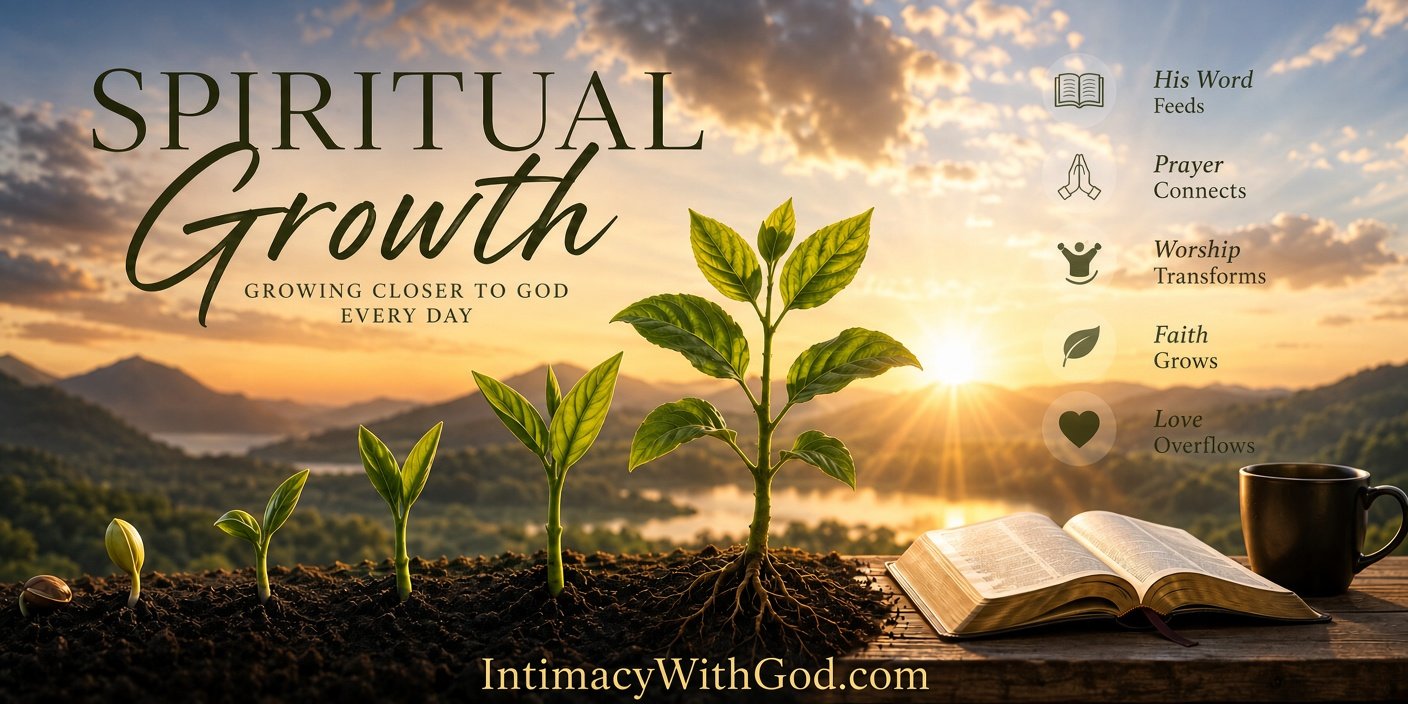
Spiritual Growth: How to Grow Closer to God and Become More Like Christ
Spiritual growth is the lifelong process of growing closer to God, knowing Him more deeply, becoming more like Jesus Christ, and allowing the Holy Spirit to transform every area of your life.
Christian spiritual growth is not simply about knowing more about the Bible or becoming more religious. It is about developing a deeper relationship with God and allowing that relationship to change the way you think, speak, live, love, pray, worship, and respond to the circumstances of life.
If you desire to grow spiritually, develop a deeper relationship with God, hear His voice more clearly, strengthen your faith, understand His Word, and become more like Christ, spiritual growth is the journey God invites every believer to pursue.
“But grow in the grace and knowledge of our Lord and Savior Jesus Christ.” — 2 Peter 3:18
What Is Spiritual Growth?
Spiritual growth is the process of becoming increasingly mature in your relationship with God and increasingly like Jesus Christ.
When you first place your faith in Christ, you begin a new life with God. But becoming a Christian is not the end of the journey. It is the beginning. It is a lifelong pursuit to have intimacy with God.
Just as a newborn child grows physically, Christians are called to grow spiritually.
Spiritual growth involves learning to:
- Know God personally
- Love God more deeply
- Trust God more completely
- Read and understand the Bible
- Develop a consistent prayer life
- Hear and recognize God's voice
- Walk by faith
- Worship God sincerely
- Obey God's Word
- Overcome spiritual struggles
- Love and serve other people
- Become more like Jesus
- Depend on the Holy Spirit
- Develop spiritual maturity
- Live according to God's purposes
Spiritual growth is therefore much more than participating in religious activities. It is an increasingly intimate relationship with God that produces transformation in your life.
Why Is Spiritual Growth Important?
God does not want you to remain spiritually immature.
The apostle Paul wrote:
“We are to grow up in every way into him who is the head, into Christ.” — Ephesians 4:15
God's desire is that believers mature in their faith and develop a life that increasingly reflects Jesus.
Spiritual maturity helps you develop greater wisdom, stronger faith, deeper love, greater discernment, and a more consistent relationship with God.
As you grow spiritually, you begin to understand God's character more clearly and recognize that Christianity is not merely about following rules. It is about knowing the God who created you and responding to His love.
Spiritual growth helps you:
Know God.
You begin to understand God's character, His promises, His purposes, and His heart.
Trust God.
Your faith becomes stronger as you experience God's faithfulness.
Understand Scripture.
The Bible becomes more than a book you read. It becomes God's Word that shapes your thinking and guides your life.
Develop intimacy with God.
Prayer becomes a genuine conversation with God rather than simply presenting Him with a list of requests.
Become more like Christ.
The goal of spiritual growth is not simply becoming a better version of yourself. It is becoming increasingly like Jesus.
Live with greater purpose.
As you grow closer to God, you become more aware of how He wants you to use your life to serve Him and others.
How Do You Grow Spiritually?
There is no single formula for spiritual growth.
However, Scripture consistently points us toward several foundational practices that help us develop a deeper relationship with God.
1. Spend Time With God
One of the most important foundations of spiritual growth is simply spending time with God.
A relationship cannot become deep without time.
If you want to know God personally, make time to seek Him.
This can include:
- Prayer
- Reading Scripture
- Worship
- Meditation on God's Word
- Silence and listening
- Confession
- Thanksgiving
- Fellowship with other believers
The objective is not to complete a religious checklist.
The objective is to know God.
Jesus regularly withdrew from the crowds to spend time with His Father.
If Jesus intentionally made time to pray, we should recognize how important time with God is for our own spiritual lives.
2. Read and Study the Bible
The Bible is foundational to spiritual growth.
God's Word teaches us who God is, reveals His purposes, shows us how to live, exposes sin, strengthens our faith, provides wisdom, and helps us understand His will.
Peter wrote:
“Like newborn infants, long for the pure spiritual milk, that by it you may grow up into salvation.” — 1 Peter 2:2
A growing Christian develops a growing hunger for God's Word.
But Bible reading should not become merely an intellectual exercise.
Ask God to help you understand what you read and show you how it applies to your life.
A simple approach to Bible study
When reading a passage, ask:
- What does this passage say?
- What does it teach me about God?
- What does it teach me about people?
- Is there a command I should obey?
- Is there a promise I should trust?
- Is there a sin I need to confess?
- Is there an example I should follow?
- How should this passage change my life?
This approach can transform Bible study from simply acquiring information into an opportunity to encounter God through His Word.
Related resource: Bible Reading and Bible Study
3. Develop a Consistent Prayer Life
Prayer is essential to spiritual growth because prayer develops our relationship with God.
Prayer is not simply asking God for things.
Prayer includes:
- Worship
- Praise
- Thanksgiving
- Confession
- Listening
- Intercession
- Asking
- Surrender
- Fellowship with God
As your relationship with God deepens, prayer can become one of the most meaningful parts of your day.
Paul encouraged believers to:
“Pray without ceasing.” — 1 Thessalonians 5:17
This does not mean you must literally speak words of prayer every moment.
It means developing a life that remains connected to God throughout the day.
You can talk with God while driving, walking, working, resting, making decisions, or facing difficult circumstances.
Related resource: Prayer
4. Learn to Hear God's Voice
An important part of developing a deeper relationship with God is learning to recognize His leading.
Jesus said:
“My sheep hear my voice, and I know them, and they follow me.” — John 10:27
God primarily speaks to us through His Word, and Scripture provides the foundation for discerning everything else.
As you become familiar with the Bible, you become better equipped to recognize what is consistent with God's character and truth.
Learning to hear God's voice also involves developing spiritual sensitivity, prayerfully seeking God's direction, and testing what you believe you are hearing against Scripture.
God's voice will never contradict God's Word.
Related resource: Hearing God's Voice
5. Worship God
Worship is an essential part of spiritual growth.
Worship is more than singing songs at church.
True worship involves giving God the honor, love, devotion, obedience, and surrender He deserves.
Paul described this kind of worship as offering our lives to God:
“Present your bodies as a living sacrifice, holy and acceptable to God, which is your spiritual worship.” — Romans 12:1
Worship can happen:
- In church
- At home
- During prayer
- While reading Scripture
- Through music
- Through obedience
- Through serving others
- Through your work
- Through giving
- Through everyday decisions
A spiritually growing Christian increasingly learns to worship God with the whole life.
Related resource: Worship
6. Seek God Wholeheartedly
Spiritual growth requires intentionality.
God promises:
“You will seek me and find me, when you seek me with all your heart.” — Jeremiah 29:13
Seeking God means making Him a priority.
It means wanting God Himself rather than simply wanting what God can give you.
There is an important difference between seeking God's blessings and seeking God.
When you seek God, you begin to desire His presence, His character, His will, and His purposes.
Related resource: Seeking God
7. Obey What God Teaches You
Spiritual growth is demonstrated through obedience.
Jesus said:
“If you love me, you will keep my commandments.” — John 14:15
Knowledge without obedience does not produce spiritual maturity.
You can read the Bible every day and still fail to allow God's Word to transform your life.
The goal is to move from:
Knowing God's Word → Understanding God's Word → Applying God's Word → Living God's Word
Every time God shows you something that needs to change, respond to Him.
Obedience is one of the ways your relationship with God becomes deeper and more real.
8. Depend on the Holy Spirit
Christian spiritual growth cannot be accomplished through human effort alone.
The Holy Spirit works within believers to transform their character and enable them to live for God.
Paul described the result as the fruit of the Spirit:
“The fruit of the Spirit is love, joy, peace, patience, kindness, goodness, faithfulness, gentleness, self-control.” — Galatians 5:22–23
Notice that spiritual growth is not primarily about becoming impressive.
It is about becoming Christlike.
The evidence of spiritual maturity is increasingly visible in the way you respond to people, difficulties, temptation, disappointment, success, and suffering.
9. Become More Like Jesus
The ultimate goal of Christian spiritual growth is Christlikeness.
Romans 8:29 says believers are being conformed to the image of God's Son.
Ask yourself:
Am I becoming more like Jesus?
Am I becoming:
- More loving?
- More patient?
- More forgiving?
- More compassionate?
- More humble?
- More obedient?
- More truthful?
- More generous?
- More willing to serve?
- More dependent upon God?
- More willing to forgive?
- More concerned about others?
These are important indicators of spiritual maturity.
Spiritual growth is not about appearing religious.
It is about allowing Christ to transform your character.
10. Fellowship With Other Believers
God did not design Christians to grow spiritually in isolation.
Healthy Christian fellowship provides encouragement, accountability, teaching, correction, prayer, and opportunities to serve.
Hebrews 10:24–25 encourages believers to consider how they can encourage one another and not neglect meeting together.
A healthy church community can help you:
- Learn God's Word
- Pray with others
- Receive encouragement
- Serve others
- Discover spiritual gifts
- Receive wise counsel
- Develop friendships
- Persevere during difficult seasons
Spiritual growth happens personally, but it should not happen completely alone.
11. Serve Others
Jesus demonstrated that spiritual maturity expresses itself through service.
He did not simply teach people.
He served them.
Christian spiritual growth should eventually move outward.
As you grow closer to God, you should become increasingly concerned about other people.
Look for opportunities to:
- Encourage someone
- Help someone in need
- Pray for someone
- Teach God's Word
- Mentor another believer
- Serve in your church
- Share the gospel
- Help people who are hurting
- Use your gifts for God's purposes
Spiritual maturity is not measured only by how much you know.
It is also revealed by how much you love and serve.
Signs You Are Growing Spiritually
Spiritual growth can sometimes be difficult to recognize because transformation often happens gradually.
Here are several signs that you may be growing spiritually.
You Desire God More
You begin wanting God's presence rather than simply wanting His blessings.
You want to know Him.
You want to spend time with Him.
You begin looking forward to prayer, worship, and Scripture.
You Hunger for God's Word
The Bible becomes increasingly important to you.
You want to understand what God is saying and how His Word applies to your life.
You Become More Sensitive to Sin
As you grow closer to God, you become more aware of attitudes, thoughts, words, and behaviors that do not reflect Christ.
Instead of hiding your sin, you become quicker to confess it and turn back to God.
You Forgive More Easily
Spiritual maturity changes how you respond when people hurt you.
Forgiveness may still be difficult, but you increasingly recognize that you have been forgiven by God and are called to extend forgiveness to others.
Your Character Changes
The fruit of the Spirit becomes increasingly evident.
You may notice greater patience, love, peace, self-control, kindness, and faithfulness.
You Trust God During Difficult Times
Spiritual maturity does not mean you never experience fear, disappointment, or doubt.
It means you increasingly learn to bring those things to God rather than allowing them to control you.
You Think Less About Yourself
As you grow spiritually, your focus increasingly moves from:
“What do I want?”
to:
“What does God want?”
and:
“How can I love and serve others?”
You Desire to Help Others Grow
A growing Christian eventually develops a desire to encourage other people in their relationship with God.
You begin to realize that what God teaches you can be used to help someone else.
What Can Prevent Spiritual Growth?
Although God desires us to grow, there are things that can hinder spiritual maturity.
Unconfessed Sin
Sin damages our fellowship with God.
When God reveals sin in your life, do not run from Him.
Run toward Him.
Confess your sin and receive His forgiveness.
Neglecting God's Word
A Christian who rarely reads Scripture will struggle to develop a strong biblical foundation.
God's Word renews our minds and gives us truth with which to evaluate our thoughts and decisions.
Neglecting Prayer
When prayer disappears from your life, your awareness of dependence upon God can diminish.
Prayer keeps us connected to God and reminds us that we need Him.
Distractions
Modern life provides endless distractions.
Phones, entertainment, social media, work, financial concerns, and everyday responsibilities can crowd out time with God.
Sometimes spiritual growth requires intentionally removing distractions.
Spiritual Complacency
It is possible to become comfortable with where you are spiritually.
But God calls us to continue growing.
Never assume that because you have been a Christian for many years, you have nothing more to learn.
Isolation
Trying to follow Christ completely alone can make spiritual growth much more difficult.
We need other believers.
Trying to Grow Through Self-Effort Alone
Christian growth is not achieved simply by trying harder.
We cooperate with the work God is doing within us.
Depend upon the Holy Spirit rather than relying entirely on your own strength.
Spiritual Growth Takes Time
One of the most important things to understand about spiritual growth is that it is a process.
You will have seasons when you feel very close to God.
You will also have seasons when God seems distant.
There will be victories.
There will be failures.
There will be times of tremendous faith and times when you struggle with doubt.
Do not measure your entire spiritual life by how you feel on one particular day.
Growth is often gradual.
Think about a tree.
You may not see it growing from one day to the next, but over months and years, the growth becomes obvious.
Your spiritual life can be similar.
God may be changing you in ways you do not immediately recognize.
How to Grow Spiritually Every Day
You do not need an elaborate religious routine to begin growing closer to God.
Start with simple, consistent practices.
A simple daily spiritual growth routine
Begin your day with God.
Spend a few minutes praying and surrendering the day to Him.
Read Scripture.
Even a short passage can become meaningful when you slow down and ask God to teach you.
Pray throughout the day.
Talk with God about your decisions, concerns, relationships, work, temptations, and opportunities.
Listen.
Give yourself quiet moments to reflect on Scripture and seek God's direction.
Practice gratitude.
Thank God for His goodness and faithfulness.
Obey what God shows you.
When Scripture or the Holy Spirit brings something to your attention, respond.
End your day with God.
Review your day, thank Him, confess your failures, and surrender tomorrow to Him.
Consistency is more important than trying to create an impossible spiritual routine.
A Practical Spiritual Growth Plan
If you want to grow closer to God, consider focusing on these seven areas:
1. Know God
Spend time learning about God's character through Scripture.
2. Talk With God
Develop a consistent prayer life.
3. Listen to God
Learn to recognize God's voice and test everything against Scripture.
4. Worship God
Make worship a lifestyle rather than simply an activity.
5. Obey God
Put God's Word into practice.
6. Become Like Christ
Ask the Holy Spirit to transform your character.
7. Serve Others
Use your life and spiritual gifts to bless other people.
These seven areas provide a practical framework for developing a deeper relationship with God.
Spiritual Growth and Intimacy With God
Spiritual growth and intimacy with God are closely connected.
The more you know God, the more you can trust Him.
The more you trust Him, the more freely you can surrender to Him.
The more you surrender, the more you experience His work in your life.
And the more you experience His faithfulness, the deeper your relationship with Him can become.
Christianity is ultimately about relationship.
God invites you to know Him—not merely to know facts about Him.
Jesus prayed:
“And this is eternal life, that they know you, the only true God, and Jesus Christ whom you have sent.” — John 17:3
Knowing God personally is at the heart of spiritual growth.
Spiritual Growth During Difficult Times
Some of the deepest spiritual growth happens during seasons of difficulty.
Trials can teach us dependence upon God in ways that comfort sometimes does not.
James wrote:
“The testing of your faith produces steadfastness.” — James 1:3
Difficult circumstances can teach you:
- Patience
- Perseverance
- Trust
- Dependence
- Compassion
- Humility
- Faith
- Hope
This does not mean that every difficult circumstance is directly caused by God.
But God can work through difficult circumstances to deepen your faith and shape your character.
When life becomes difficult, ask:
“God, what do You want to teach me through this?”
Rather than only asking:
“God, how quickly can You remove this?”
Both prayers may be appropriate, but the first can open your heart to what God wants to accomplish within you.
How to Know If You Are Spiritually Mature
Spiritual maturity is not measured by how long you have been a Christian.
It is not measured simply by how many Bible verses you know.
It is not measured by how many church services you attend.
And it is not measured by how religious you appear to other people.
Spiritual maturity is increasingly reflected in your character and relationship with God.
A spiritually mature Christian increasingly:
- Loves God
- Loves people
- Understands Scripture
- Obeys God's Word
- Depends on the Holy Spirit
- Practices forgiveness
- Walks in humility
- Serves others
- Handles trials with faith
- Discerns truth from error
- Takes responsibility for sin
- Seeks God's will
- Desires God's presence
- Helps others grow
The goal is not perfection.
The goal is transformation.
Bible Verses About Spiritual Growth
Here are several important Bible passages to study as you pursue spiritual growth.
2 Peter 3:18
“But grow in the grace and knowledge of our Lord and Savior Jesus Christ.”
Ephesians 4:15
“We are to grow up in every way into him who is the head, into Christ.”
Romans 12:2
“Be transformed by the renewal of your mind.”
Galatians 5:22–23
The fruit of the Spirit includes love, joy, peace, patience, kindness, goodness, faithfulness, gentleness, and self-control.
Philippians 1:6
God is faithful to complete the good work He has begun in His people.
John 15:5
Jesus teaches that those who abide in Him will bear fruit.
Colossians 2:6–7
Paul encourages believers to walk in Christ, rooted and built up in Him.
Psalm 1:1–3
The person who delights in God's law is compared to a tree planted by streams of water.
James 1:2–4
Trials can produce steadfastness and spiritual maturity.
Frequently Asked Questions About Spiritual Growth
What is spiritual growth in Christianity?
Spiritual growth in Christianity is the lifelong process of becoming more mature in your faith, growing closer to God, understanding His Word, developing Christlike character, and becoming more like Jesus through the work of the Holy Spirit.
How can I grow spiritually?
You can grow spiritually by spending time with God, reading and studying the Bible, praying consistently, worshiping God, obeying His Word, depending upon the Holy Spirit, participating in Christian fellowship, and serving others.
How do I grow closer to God?
To grow closer to God, intentionally seek Him through prayer, Scripture, worship, obedience, and fellowship. The goal is not simply to perform religious activities but to develop a genuine relationship with God.
What are the signs of spiritual growth?
Signs of spiritual growth include a growing desire for God, increasing hunger for Scripture, greater trust in God, repentance from sin, increasing love for others, greater patience and self-control, deeper prayer, and a growing desire to become like Christ.
How long does spiritual growth take?
Spiritual growth is a lifelong process. God can transform your life quickly in some areas, while other areas may take years of growth, experience, obedience, and dependence upon Him.
Why am I not growing spiritually?
Spiritual stagnation can have many causes, including neglecting prayer or Scripture, unconfessed sin, distractions, isolation, discouragement, spiritual complacency, or relying on your own strength instead of depending upon God.
Can you grow spiritually without reading the Bible?
The Bible is foundational to Christian spiritual growth. While spiritual growth involves prayer, worship, fellowship, service, and other practices, Scripture provides the essential foundation for knowing God and discerning truth.
Does suffering help spiritual growth?
Difficult circumstances can become opportunities for spiritual growth by teaching perseverance, dependence upon God, humility, compassion, and faith. God can use trials to shape our character even when we do not understand why they are happening.
What is the ultimate goal of spiritual growth?
The ultimate goal is to know God and become increasingly like Jesus Christ. Spiritual maturity is ultimately about transformation—not simply gaining more religious knowledge.
Begin Your Journey of Spiritual Growth
You do not have to become spiritually mature overnight.
You simply need to take the next step.
Spend time with God today.
Open His Word.
Talk to Him.
Listen.
Worship Him.
Confess what needs to be confessed.
Obey what He shows you.
Trust Him with what you cannot control.
And continue walking with Him.
God is not asking you to manufacture spiritual growth through your own strength.
He invites you into a relationship with Him.
As you seek Him, learn His Word, depend upon the Holy Spirit, and follow Jesus, God can transform your life from the inside out.
“But grow in the grace and knowledge of our Lord and Savior Jesus Christ.” — 2 Peter 3:18
Spiritual growth is a lifelong journey of knowing God, growing closer to Him, and becoming more like Jesus.
More Bible Studies & Articles About Spiritual Growth
Prayer: How to Pray and Grow Closer to God
Intimacy With God: How to Grow Closer to God and Know Him Personally
How to Grow Closer to God Daily
Worship: How to Worship God and Draw Closer to
Continue Growing Closer to God
Explore these related resources on Intimacy With God:
- Intimacy With God — Discover how to develop a deeper relationship with God.
- Prayer — Learn how to develop a deeper and more meaningful prayer life.
- Reading the Bible and Bible Study — Learn how to read, understand, and apply God's Word.
- Hearing God's Voice — Learn how to recognize God's leading and discern His voice through Scripture.
- Worship — Discover how worship can become a lifestyle.
- Seeking God — Learn what it means to seek God wholeheartedly.
- Knowing God Personally — Discover what it means to have a personal relationship with God.
- Spiritual Growth - What is spiritual growth? How can you grow closer to God and more like Jesus?
- Waiting on God — Learn how to trust God during seasons when you are waiting for His direction.
- The Holy Spirit( - learn opens in new tab) - Learn who the Holy Spirit is, what the Holy Spirit does...
- God's Purpose For Your Life - how you can discover God's purpose & calling & mission
- Sharing the Gospel of Jesus: How Sharing Your Faith Deepens your Intimacy With God
The goal isn't simply to learn more about God.
The goal is to know God personally, love Him deeply, hear His voice, walk with Him daily, and experience a growing intimacy with Him.
 Kevin Bart has been a follower of Jesus for over 40 years. Kevin has taught Bible study classes, small groups, and discipleship classes for many years. He developed Pursuing Intimacy With God Bible studies website and book after many years of seeking God and studying His word. Kevin and his wife Nancy have 3 sons and 2 precious grandchildren.
Kevin is a former business owner, and current international missions ministry leader with more than four decades of combined business and ministry experience. After building and running a successful business for 23 years, with God’s guidance and blessings, he sold his company to dedicate himself to full-time global missions.
For over 20 years, Kevin and his wife Nancy have led a self funded international missions ministry. Utilizing learned business and financial management skills, as well as knowledge and experience in travel points and miles, to date they have had more than 5o mission trips to 36 countries in the Caribbean, Central America, South America, Europe, Africa, and Asia.
After many years of studying the Bible and the Book of Revelation, and writing many Bible studies and articles, Kevin finally finished Unraveling The Mysteries of the Book Of Revelation. Hopefully it will be a blessing to many people.


