
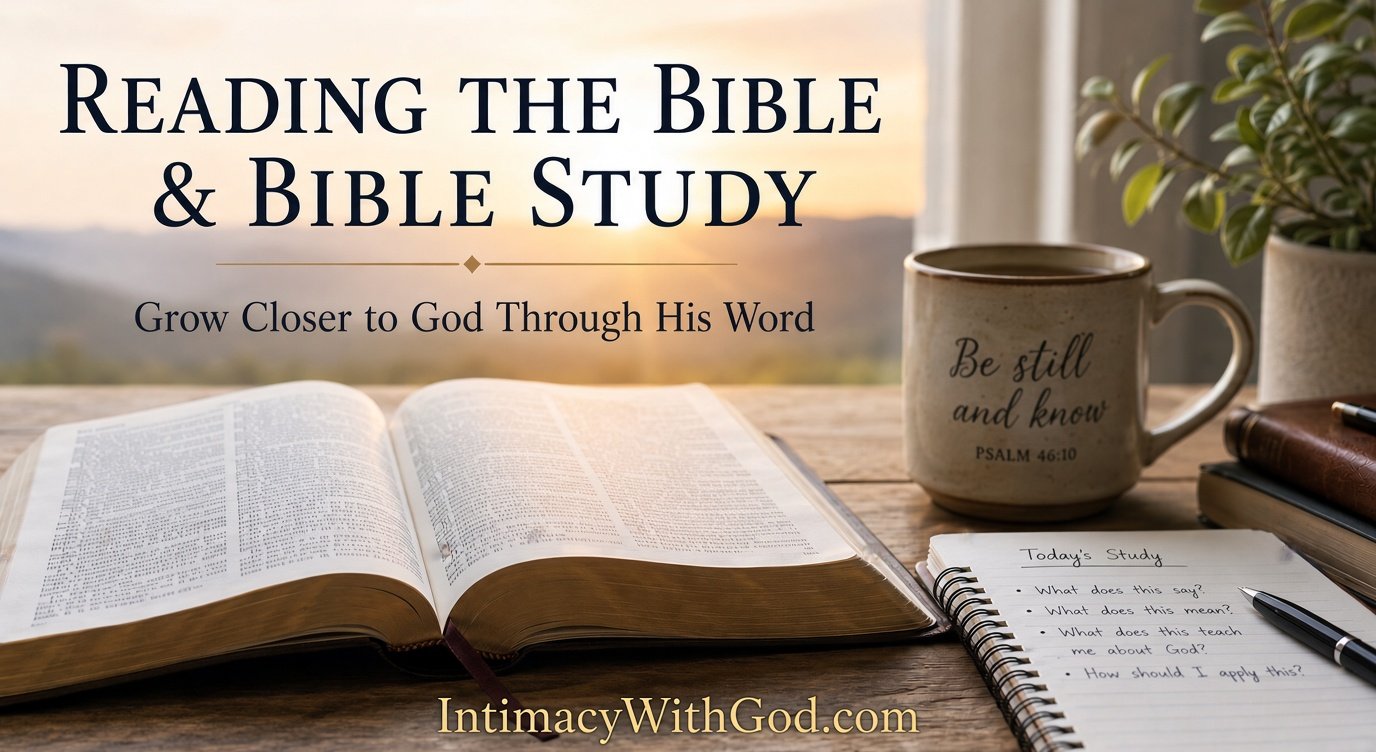
Reading The Bible And Bible Study: How to Know God Through His Word
Reading the Bible is one of the most important ways to grow closer to God, know Him personally, strengthen your faith, and discover His will for your life. But simply reading the words on a page is not the same as studying and applying God's Word.
Whether you are new to the Bible or have been studying Scripture for years, learning how to read the Bible effectively and how to study the Bible can transform your relationship with God.
The Bible reveals who God is, what He has done, what He desires for His people, and how we can live in a way that honors Him. Through Scripture, we learn about God's character, His promises, His purposes, His commands, His grace, and His plan of salvation through Jesus Christ.
This guide will help you learn how to read the Bible, how to study the Bible, how to understand Scripture, how to apply God's Word to your life, and how to develop a consistent Bible reading and Bible study habit.
Why Is Reading the Bible Important?
The Bible is not simply an ancient collection of religious writings. It is God's Word and is essential to the Christian life.
Reading Scripture helps us understand God and His purposes. It teaches us truth, gives us wisdom, strengthens our faith, corrects us when we are going the wrong direction, and encourages us when life is difficult.
The Bible says:
“All Scripture is breathed out by God and profitable for teaching, for reproof, for correction, and for training in righteousness.”
— 2 Timothy 3:16
Regular Bible reading allows God's truth to become increasingly familiar to us. As we spend time in Scripture, we learn to recognize biblical principles and understand how they apply to our everyday decisions.
Reading the Bible Helps You Know God
One of the greatest reasons to read the Bible is to know God more deeply.
The Bible reveals God's character. We see His holiness, love, mercy, justice, patience, wisdom, faithfulness, power, and grace.
We also see God's relationship with people throughout history. From Genesis through Revelation, Scripture tells the story of God's work in the world and His redemptive plan.
Bible reading therefore should not become merely an intellectual exercise. The ultimate goal is not simply to know more about the Bible but to know God more intimately.
Reading the Bible and Growing Closer to God
If your desire is to develop a deeper relationship with God, Bible reading should be an important part of your spiritual life.
Prayer and Bible study work together.
When we pray, we talk to God. When we read Scripture, we listen to what God has revealed through His Word.
This does not mean that every Bible verse is a personal message specifically directed to us. Rather, Scripture gives us God's revealed truth and teaches us how to understand His character, His ways, and His will.
As you read the Bible, ask:
- What does this passage teach me about God?
- What does this passage teach me about Jesus?
- What does this passage teach me about myself?
- What does this passage reveal about God's purposes?
- Is there a command I should obey?
- Is there a promise I should trust?
- Is there a warning I should take seriously?
- Is there an example I should follow or avoid?
- How should this passage affect the way I live?
These questions can turn Bible reading into meaningful Bible study and spiritual growth.
How to Read the Bible Effectively
Many people want to read the Bible consistently but do not know where to begin.
Others begin with enthusiasm but eventually stop because they find some passages difficult to understand.
A good Bible reading approach can make a significant difference.
1. Begin With Prayer
Before reading the Bible, ask God to help you understand His Word and respond to it faithfully.
You might pray:
“Lord, help me understand Your Word. Show me what this passage teaches about You, help me understand its meaning, and give me the grace to apply it to my life.”
Prayer reminds us that Bible study is more than gaining information. We want God's truth to transform our hearts and lives.
2. Read the Bible in Context
One of the most important principles of Bible study is context.
Never build an important interpretation of Scripture around one isolated verse.
Read the verses before and after the passage. Consider the chapter, book, historical setting, intended audience, literary style, and overall message.
Ask:
Who wrote this?
Who was it written to?
Why was it written?
What was happening when it was written?
What does the passage mean in its immediate context?
Context protects us from taking verses out of their intended meaning.
3. Read Entire Books of the Bible
Although studying individual verses can be helpful, reading entire books of the Bible helps you understand the larger message.
For example, when reading the Gospel of John, don't approach every chapter as an isolated lesson.
Consider the overall purpose of John's Gospel and how each section contributes to the story.
The same principle applies to Romans, Ephesians, Hebrews, Revelation, Genesis, Psalms, and every other book of Scripture.
Recommended Bible Reading Approach
If you are new to Bible reading, consider beginning with:
- The Gospel of John
- Mark
- Luke
- Acts
- Ephesians
- Philippians
- Genesis
- Psalms
- Proverbs
- Romans
You can then expand into other books and eventually read through the entire Bible.
4. Read Slowly
Bible reading does not need to be a race.
Reading several chapters quickly can be useful for gaining an overview of a book, but slower reading can be valuable when you want to meditate on Scripture and understand its meaning.
Sometimes a single paragraph contains more spiritual truth than you can absorb in one sitting.
Read carefully.
Pause.
Think about what you have read.
Ask questions.
Write down insights.
Pray about what you are learning.
5. Read the Bible Regularly
Consistency is more important than trying to create a perfect Bible reading schedule.
A person who reads the Bible for 15 minutes every day may develop a deeper understanding of Scripture than someone who reads for two hours once every few weeks.
Develop a realistic routine.
You might read the Bible:
- Early in the morning
- During your lunch break
- In the evening
- Before going to bed
- During a dedicated quiet time with God
The important thing is to establish a sustainable habit of spending time in God's Word.
How to Study the Bible
Bible study goes beyond simply reading a passage.
Reading asks, “What does the Bible say?”
Bible study also asks, “What does this passage mean, and how should I respond?”
A simple Bible study process is:
Observe → Interpret → Apply
Observation: What Does the Passage Say?
Start by carefully observing the text.
Look for:
- Repeated words
- Important ideas
- Commands
- Promises
- Warnings
- Contrasts
- Comparisons
- Questions
- People
- Places
- Events
- Cause-and-effect relationships
- Key themes
Don't immediately jump to application.
First understand what the passage actually says.
Interpretation: What Does the Passage Mean?
After observing the passage, determine what it means in its context.
Ask:
What was the author's intended meaning?
Consider the historical and cultural setting.
Look at related passages.
Compare Scripture with Scripture.
Use trustworthy Bible study resources when necessary.
Be careful not to make the Bible say what you want it to say.
The goal of Bible study is not to make Scripture agree with our opinions.
The goal is to allow Scripture to correct our opinions when necessary.
Application: How Should I Respond?
The final step is application.
Ask:
How should this truth change my life?
Biblical knowledge should lead to biblical living.
A passage may call you to:
- Trust God
- Obey a command
- Change an attitude
- Forgive someone
- Resist temptation
- Encourage another person
- Strengthen your faith
- Repent of sin
- Serve others
- Pray
- Love God more deeply
The goal of Bible study is not simply to fill your notebook.
It is to transform your life.
A Simple Bible Study Method
One of the easiest ways to develop a consistent Bible study method is to use four questions:
1. What does the passage say?
Read the text carefully.
2. What does the passage mean?
Study the context and determine the author's intended meaning.
3. What does this teach me about God?
Look for what Scripture reveals about God's character, purposes, promises, and ways.
4. How should I respond?
Identify a practical way to obey, trust, believe, or apply what you have learned.
This simple method can be used for almost any passage of Scripture.
How to Study the Bible for Beginners
If you are a beginner, don't feel overwhelmed by the size of the Bible.
The Bible contains 66 books, written across many centuries, with different literary styles and historical settings.
You do not need to understand everything immediately.
Start with the fundamentals.
Step 1: Choose a Bible Translation
Select a reliable translation that you can understand.
Some commonly used English translations include:
- English Standard Version (ESV)
- New International Version (NIV)
- New American Standard Bible (NASB)
- Christian Standard Bible (CSB)
- New King James Version (NKJV)
- New Living Translation (NLT)
It can also be helpful to compare several translations when studying a difficult passage.
Step 2: Choose a Book of the Bible
Instead of randomly opening the Bible every day, consider studying one book at a time.
This allows you to understand the context and overall message.
Step 3: Read the Passage Several Times
Read the passage slowly.
Read it again.
Notice words and ideas that stand out.
Step 4: Ask Questions
Write down your questions.
What don't you understand?
Who is speaking?
Who is being addressed?
What happened before this?
What happens afterward?
Step 5: Study the Passage
Use cross-references, Bible dictionaries, commentaries, maps, concordances, and other trustworthy Bible study resources.
Step 6: Apply What You Learn
Ask God to help you live according to what you have discovered.
What Is the Best Way to Study the Bible?
There is no single Bible study method that works equally well for every Christian.
Different approaches can be helpful depending on your purpose.
Topical Bible Study
A topical Bible study examines what Scripture teaches about a particular subject.
Examples include:
- Prayer
- Faith
- Love
- Forgiveness
- Anxiety
- Wisdom
- Spiritual growth
- Hearing God's voice
- Intimacy with God
- The Holy Spirit
- Salvation
- Marriage
- Discipleship
A topical study can help you discover what the Bible teaches about an important area of life.
Book-by-Book Bible Study
A book-by-book study focuses on an entire biblical book.
This approach is excellent for understanding:
- Context
- Structure
- Themes
- Historical background
- Author
- Audience
- Purpose
- Major teachings
Studying an entire book also helps prevent isolated verses from being interpreted outside their context.
Character Bible Study
A character study examines the life of a person in Scripture.
You could study:
- Abraham
- Moses
- David
- Ruth
- Esther
- Daniel
- Peter
- Paul
- Mary
- John the Baptist
Ask what the person's life teaches you about faith, obedience, failure, repentance, courage, and God's faithfulness.
Word Study
A word study examines how a particular biblical word is used throughout Scripture.
This can be especially useful for important theological concepts such as:
- Faith
- Grace
- Love
- Hope
- Salvation
- Righteousness
- Redemption
- Holiness
When conducting a word study, be careful not to assume that a word always has exactly the same meaning in every passage.
Context remains essential.
How to Understand the Bible
Sometimes the Bible is difficult to understand.
That is normal.
Some passages are straightforward. Others require careful study because they involve ancient cultures, unfamiliar customs, symbolism, prophecy, poetry, or complex theological ideas.
When you encounter a difficult passage, don't immediately assume you cannot understand it.
Try these steps.
Read the passage repeatedly.
Familiarity often reveals details you missed during your first reading.
Read the surrounding context.
Look at the entire chapter and, when necessary, the entire book.
Compare other passages.
Allow clearer passages to help illuminate less obvious ones.
Consider the historical setting.
Understanding the world in which a biblical book was written can clarify many difficult passages.
Use trustworthy Bible study resources.
A good commentary, Bible dictionary, concordance, or study Bible can provide valuable historical and linguistic information.
Don't build major doctrines on obscure verses.
Important biblical teachings should be grounded in the broader teaching of Scripture.
Reading the Bible for Spiritual Growth
Bible reading is one of the foundational practices of spiritual growth.
As you learn God's Word, you gain a deeper understanding of His character and His ways.
Scripture can challenge wrong thinking, expose unhealthy attitudes, encourage faith, and provide wisdom for everyday life.
Psalm 119 repeatedly celebrates the value of God's Word.
Jesus also emphasized the importance of God's Word when He said:
“Man shall not live by bread alone, but by every word that comes from the mouth of God.”
— Matthew 4:4
The Bible nourishes our spiritual lives by continually directing our attention toward God.
Meditating on Scripture
Bible reading and Bible study should also lead to meditation on God's Word.
Biblical meditation is not about emptying your mind.
It involves thoughtfully reflecting on God's truth.
After reading a passage, slow down and consider what you have learned.
You might repeat an important truth from the passage.
Think about its meaning.
Pray about it.
Consider how it applies to your circumstances.
Psalm 1 describes the person who delights in God's law and meditates on it day and night.
Meditating on Scripture helps God's truth move from something we have merely read to something we continually remember.
How to Make Bible Reading a Daily Habit
One of the biggest challenges is consistency.
Many Christians begin a Bible reading plan with enthusiasm but eventually stop.
The solution is not necessarily a more complicated plan.
It is often a simpler one.
Start small.
Begin with 10–15 minutes a day if necessary.
Pick a consistent time.
A regular time makes Bible reading easier to remember.
Keep your Bible accessible.
Have your Bible available wherever you normally spend your quiet time.
Keep a Bible journal.
Write down important observations, questions, prayers, and applications.
Don't quit when you miss a day.
Missing one day doesn't mean you have failed.
Simply begin again the next day.
Focus on knowing God rather than completing a checklist.
A Bible reading plan can be helpful, but the ultimate goal is not to check off chapters.
The goal is to know God, understand His Word, love Him, and follow Him.
Bible Study and Prayer
Prayer and Bible study belong together.
As you study Scripture, allow what you read to shape your prayers.
If you read about God's faithfulness, thank Him for His faithfulness.
If Scripture reveals an area of sin, confess it.
If you discover a command, ask God for strength to obey it.
If you encounter a promise, respond with faith.
If you read about someone in need, pray for people experiencing similar circumstances.
This approach turns Bible study into a conversation of sorts: Scripture shapes what we think and believe, and prayer allows us to respond to God.
How the Bible Helps You Hear God's Voice
Christians sometimes ask, “How can I hear God's voice?”
One of the most important answers is that we should become deeply familiar with what God has already revealed through Scripture.
The Bible provides an objective foundation for discerning what is consistent with God's character and truth.
Personal impressions should never be treated as equal to Scripture.
Instead, Scripture should remain the standard by which our beliefs and spiritual impressions are evaluated.
The more deeply we know God's Word, the better equipped we are to recognize teachings and ideas that contradict it.
This is one reason reading the Bible and studying Scripture are so important for spiritual discernment.
Bible Reading Plans
A Bible reading plan can provide structure and help you read through larger portions of Scripture.
There are many different approaches.
Chronological Bible Reading Plan
This approach attempts to read biblical events in approximate chronological order.
One-Year Bible Reading Plan
This approach divides Scripture into daily readings designed to cover the Bible in approximately one year.
New Testament Reading Plan
This is a good option for someone who wants to begin with the life of Jesus and the early Christian church.
Psalms and Proverbs Reading Plan
Reading one Psalm or one chapter of Proverbs regularly can be an excellent way to develop a habit of Scripture reading.
Book-by-Book Reading Plan
This approach focuses on completing one biblical book before moving to another.
The best Bible reading plan is one that helps you consistently engage with Scripture and grow in your relationship with God.
Bible Study Tools That Can Help
You don't need an enormous library to study the Bible.
However, several tools can be useful.
Study Bible
A study Bible often includes:
- Historical notes
- Cross-references
- Maps
- Introductions
- Explanations
- Charts
- Book outlines
Bible Concordance
A concordance helps you locate passages containing particular words.
Bible Dictionary
A Bible dictionary provides information about biblical people, places, concepts, objects, and cultural practices.
Bible Commentary
A trustworthy commentary provides additional explanation and historical context.
Use commentaries as helpful resources, but don't allow someone else's interpretation to replace your own careful reading of Scripture.
Bible Maps
Maps can help you understand the geographical context of biblical events.
This is especially useful when studying the journeys of Abraham, Moses, Jesus, Paul, and others.
How to Take Notes During Bible Study
Taking notes can greatly improve your Bible study.
Consider creating four sections in your notebook:
Observation
What does the passage say?
Interpretation
What does it mean?
God
What does it teach me about God?
Application
How should I respond?
You can also write down:
- Questions
- Cross-references
- Important verses
- Definitions
- Historical information
- Personal prayers
- Spiritual insights
- Things you want to study later
Don't worry about creating perfect notes.
The purpose is to help you engage with God's Word.
Common Bible Study Mistakes to Avoid
Good Bible study requires humility and careful attention.
Here are several mistakes to avoid.
Taking Verses Out of Context
A verse can sound as though it means one thing when separated from the surrounding passage.
Always consider context.
Reading Only What You Already Agree With
Allow Scripture to challenge you.
The purpose of Bible study is not merely to confirm our existing opinions.
Making Every Passage About Yourself
The Bible certainly contains applications for our lives, but every passage should first be understood according to its original meaning and context.
Ignoring Historical Context
The Bible was written in real historical settings.
Understanding those settings can dramatically improve your interpretation.
Depending Entirely on Other People's Interpretations
Books, sermons, websites, and commentaries can be valuable.
But you should personally read and study Scripture.
Studying Without Applying
Knowledge without obedience does not accomplish what God intends.
James 1:22 says:
“But be doers of the word, and not hearers only.”
Bible study should ultimately affect the way we live.
The Goal of Bible Study Is Transformation
It is possible to know a great deal about the Bible without allowing God's Word to transform your life.
The goal of Scripture is not merely information.
It is transformation.
As you read and study the Bible, ask God to help you become more like Christ.
Let Scripture influence:
- Your thoughts
- Your priorities
- Your relationships
- Your decisions
- Your words
- Your attitudes
- Your habits
- Your character
- Your relationship with God
The more we understand God's truth, the more opportunity we have to respond to it faithfully.
Reading the Bible With Jesus at the Center
For Christians, the Bible ultimately points us toward Jesus Christ.
Jesus taught His disciples that the Scriptures testify about Him.
The Old Testament anticipates God's redemptive work, while the New Testament records the life, death, resurrection, teachings, and continuing work of Jesus and the early church.
When reading Scripture, ask:
What does this passage reveal about God's plan of redemption?
How does this passage relate to Jesus?
What does this teach me about following Christ?
This approach helps Bible study become more than an academic exercise.
It becomes part of our relationship with Jesus.
How Reading the Bible Changes Your Life
Consistent engagement with God's Word can gradually reshape the way you think and live.
You may become more aware of God's character.
You may develop greater wisdom.
You may become more sensitive to sin.
You may gain encouragement during difficult seasons.
You may become more confident in God's promises.
You may develop a stronger desire to pray.
You may grow in your love for God.
You may become better equipped to encourage other people with biblical truth.
Spiritual growth usually happens over time.
Don't become discouraged if you don't see immediate results.
Keep reading.
Keep studying.
Keep praying.
Keep obeying.
Keep seeking God.
Frequently Asked Questions About Reading the Bible and Bible Study
How often should I read the Bible?
Ideally, develop a consistent habit of reading Scripture regularly. Daily Bible reading is an excellent goal, but consistency is more important than trying to follow an unrealistic schedule.
How long should I study the Bible?
There is no required amount of time. Even 15–20 minutes of focused Bible study can be valuable. As you grow, you may naturally want to spend more time studying Scripture.
What book of the Bible should I read first?
The Gospel of John is an excellent starting point for someone who wants to learn about Jesus. Mark is another accessible Gospel. Acts is helpful for understanding the early church.
What is the difference between Bible reading and Bible study?
Bible reading generally involves reading Scripture to understand and absorb its message. Bible study involves more detailed examination of the text, including context, meaning, cross-references, historical background, and application.
Both are valuable.
What is the best Bible study method?
There is no single best method for everyone. The observation–interpretation–application approach is a simple and effective starting point. Topical studies, character studies, word studies, and book-by-book studies can also be valuable.
Should I read the Bible from Genesis to Revelation?
You can, and reading the entire Bible is extremely valuable. However, beginners may find it easier to begin with a Gospel such as John before attempting a cover-to-cover reading plan.
What should I do when I don't understand a Bible passage?
Read the surrounding context, compare other passages of Scripture, consider the historical setting, and consult trustworthy Bible study resources. Don't be discouraged by difficult passages.
How can I understand the Bible better?
Read consistently, study context, learn about biblical history and culture, compare Scripture with Scripture, ask good questions, take notes, pray, and use trustworthy study resources.
Can Bible reading help me grow closer to God?
Yes. Scripture reveals God's character, His purposes, His promises, and His will. As you read and respond to God's Word, Bible reading can become an important part of developing a deeper relationship with Him.
Start Reading and Studying the Bible Today
You don't have to become a Bible scholar before you can begin studying God's Word.
Start today.
Choose a passage.
Pray.
Read slowly.
Pay attention.
Ask questions.
Look at the context.
Discover what the passage teaches about God.
Think about how it applies to your life.
Then respond to God.
The goal of Bible study is not simply to finish another chapter. The goal is to know God more deeply, love Him more fully, understand His truth, and live according to His Word.
If you want to grow closer to God, make Scripture a central part of your spiritual life.
Read the Bible.
Study the Bible.
Meditate on God's Word.
Pray about what you learn.
Obey what God has revealed.
And continue seeking a deeper intimacy with God.
More Helpful Bible Studies About God's Word
How to Read and Study The Bible
Meditate On God's Word the Bible: A Biblical Guide to Meditating
Hearing God's Voice through God's Word, Prayer...
How to Hear God's Voice: 10 Biblical Ways to Know When God Is Speaking
Continue Growing Closer to God
Explore these related resources on Intimacy With God:
- Intimacy With God — Discover how to develop a deeper relationship with God.
- Prayer — Learn how to develop a deeper and more meaningful prayer life.
- Reading the Bible and Bible Study — Learn how to read, understand, and apply God's Word.
- Hearing God's Voice — Learn how to recognize God's leading and discern His voice through Scripture.
- Worship — Discover how worship can become a lifestyle.
- Seeking God — Learn what it means to seek God wholeheartedly.
- Knowing God Personally — Discover what it means to have a personal relationship with God.
- Spiritual Growth - What is spiritual growth? How can you grow closer to God and more like Jesus?
- Waiting on God — Learn how to trust God during seasons when you are waiting for His direction.
- The Holy Spirit( - learn opens in new tab) - Learn who the Holy Spirit is, what the Holy Spirit does...
- God's Purpose For Your Life - how you can discover God's purpose & calling & mission
- Sharing the Gospel of Jesus: How Sharing Your Faith Deepens your Intimacy With God
The goal isn't simply to learn more about God.
The goal is to know God personally, love Him deeply, hear His voice, walk with Him daily, and experience a growing intimacy with Him.
 Kevin Bart has been a follower of Jesus for over 40 years. Kevin has taught Bible study classes, small groups, and discipleship classes for many years. He developed Pursuing Intimacy With God Bible studies website and book after many years of seeking God and studying His word. Kevin and his wife Nancy have 3 sons and 2 precious grandchildren.
Kevin is a former business owner, and current international missions ministry leader with more than four decades of combined business and ministry experience. After building and running a successful business for 23 years, with God’s guidance and blessings, he sold his company to dedicate himself to full-time global missions.
For over 20 years, Kevin and his wife Nancy have led a self funded international missions ministry. Utilizing learned business and financial management skills, as well as knowledge and experience in travel points and miles, to date they have had more than 5o mission trips to 36 countries in the Caribbean, Central America, South America, Europe, Africa, and Asia.
After many years of studying the Bible and the Book of Revelation, and writing many Bible studies and articles, Kevin finally finished Unraveling The Mysteries of the Book Of Revelation. Hopefully it will be a blessing to many people.


